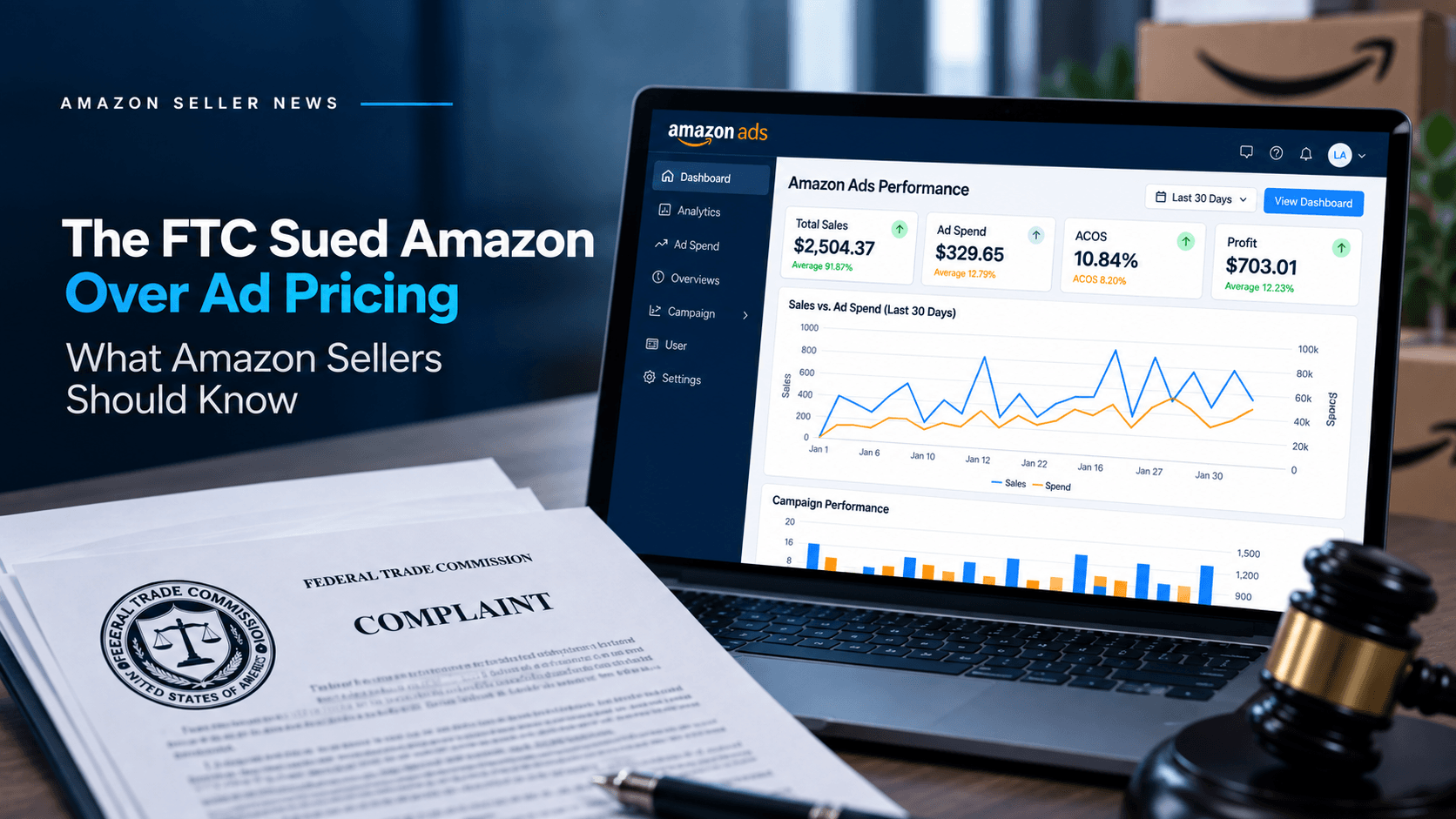
The FTC Just Sued Amazon Over Ad Pricing: What Amazon Sellers Should Know
GF
Amazon advertising is facing new scrutiny.
On August 31, 2026, the U.S. Federal Trade Commission, or FTC, and 22 states filed a lawsuit against Amazon. The complaint alleges that Amazon used undisclosed pricing practices in its advertising auctions that caused advertisers to pay more than they otherwise would have.
The allegations involve Amazon’s Sponsored Products, Sponsored Brands, and Display Ads. Amazon disputes the claims and says its advertising system has actually delivered better results for advertisers at similar or lower costs.
So, what does this actually mean for Amazon sellers?
First, What Is the Issue?
Think of Amazon advertising as an auction.
You want your product to appear when someone searches for a keyword, such as “hockey stick.”
You set a maximum bid for that click.
Amazon has traditionally described its advertising auctions using a second price model. In simple terms, the idea was that winning an auction did not necessarily mean paying your full bid. The amount you paid was influenced by what was needed to beat the next advertiser.
The FTC now alleges that Amazon changed how this worked beginning around 2019.
According to the complaint, Amazon introduced an undisclosed pricing mechanism that could push the final price above the amount determined by advertiser competition. The FTC refers to this as a “soft reserve price.”
The complaint alleges that Sponsored Products advertisers were paying their full winning bid about 80 percent of the time by 2024, compared with roughly 30 to 40 percent in 2021.
That is the central issue behind the lawsuit.
Amazon’s Response
Amazon strongly disagrees with the FTC’s allegations.
Amazon says advertisers are not simply paying more without getting anything in return. It argues that its advertising system considers relevance and expected performance, rather than simply giving every placement to the highest bidder.
Amazon also says that average winning bids for Sponsored Products fell by 50 percent between 2019 and 2025, while conversion rates improved. According to Amazon, advertisers received better results without a corresponding increase in average cost per click.
In other words, the FTC says Amazon’s pricing practices caused advertisers to pay more, while Amazon says the FTC is oversimplifying how its advertising system works.
The case is still pending, so there is no final ruling on these allegations.
Does This Change Your Amazon Ads Today?
Not directly.
The lawsuit does not mean sellers need to pause their campaigns, stop advertising, or suddenly cut their bids.
However, it does give sellers a good reason to take a closer look at what they are actually paying for their advertising.
Instead of looking only at your total ad spend, look at the relationship between your bid, CPC, clicks, conversion, sales, and profit.
For example, if you increase a keyword’s bid from $1.00 to $1.50, ask yourself:
Did that extra 50 cents actually produce more profitable sales?
If your CPC goes up but your conversion rate and sales do not improve enough to justify the additional cost, the higher bid may not be helping your business.

What Should Sellers Watch?
1. Your Actual CPC
Do not assume that your maximum bid is the same as what you will actually pay.
Look at your actual CPC over time and watch for significant changes.
2. Conversion Rate
A higher CPC is not necessarily a bad thing if the additional traffic converts well.
The important question is whether the additional cost produces enough additional sales.
3. ACOS and TACOS
Do not look at advertising in isolation.
A campaign can generate plenty of sales while still putting pressure on your overall profit.
4. Profit Per Order
This may be the most important number.
If your product makes $10 before advertising and you spend $6 to generate the sale, you need to understand whether that advertising cost still makes sense for the product.
5. Performance During Major Shopping Events
The FTC complaint specifically alleges that Amazon’s pricing practices could result in greater increases during high volume events such as Prime Day and Black Friday. These are allegations, not established facts.
For sellers, it may be useful to compare advertising performance during major events with normal periods.
The Bigger Lesson for Amazon Sellers
Regardless of how this lawsuit ultimately turns out, it highlights something important.
Your Amazon advertising strategy should be based on your own numbers, not assumptions about how the auction works.
Do not increase a bid simply because Amazon recommends it.
Do not judge a campaign only by sales.
And do not assume that more advertising automatically means more profit.
Look at what you are spending, what you are getting back, and whether the additional sales are actually worth the additional cost.
The FTC’s case is still pending, and Amazon strongly disputes the allegations. For now, sellers do not need to panic, but they should pay attention.
The best question is not, “Is Amazon Ads expensive?”
It is:
“Do I know exactly what I am getting back for every dollar I am spending?”
_________________________________________________________
Disclaimer
This post reflects publicly available information from the FTC complaint, Amazon’s official response, and reporting as of August 31, 2026.
Sources
FTC: https://www.ftc.gov/news-events/news/press-releases/2026/08/ftc-states-sue-amazon-over-secret-ad-surcharge-scheme?
Amazon: https://www.aboutamazon.com/company-news/amazon-ftc-sponsored-ads-lawsuit-response
Want More From Your Amazon Advertising?
If you’re looking for support managing and growing your Amazon business, Jetfold Commerce can help.
Book a strategy call with us here.